深度学习笔记(二):简单神经网络,后向传播算法及实现
在之前的深度学习笔记(一):logistic分类 中,已经描述了普通logistic回归以及如何将logistic回归用于多类分类。在这一节,我们再进一步,往其中加入隐藏层,构建出最简单的神经网络2.简单神经网络及后向传播算法2.1 大概描述和公式表达神经网络的大概结构如图所示,从左往右,分别是输入层,隐藏层,输出层,分别记为x\mathbf x,h\mathbf h, y\mathb
·
深度学习笔记(一):logistic分类
深度学习笔记(二):简单神经网络,后向传播算法及实现
深度学习笔记(三):激活函数和损失函数
深度学习笔记:优化方法总结(BGD,SGD,Momentum,AdaGrad,RMSProp,Adam)
深度学习笔记(四):循环神经网络的概念,结构和代码注释
深度学习笔记(五):LSTM
深度学习笔记(六):Encoder-Decoder模型和Attention模型
在之前的深度学习笔记(一):logistic分类 中,已经描述了普通logistic回归以及如何将logistic回归用于多类分类。在这一节,我们再进一步,往其中加入隐藏层,构建出最简单的神经网络
2.简单神经网络及后向传播算法
2.1 大概描述和公式表达
神经网络的大概结构如图所示,
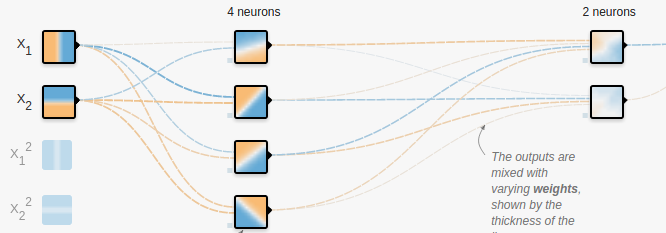
从左往右,分别是输入层,隐藏层,输出层,分别记为 x <script type="math/tex" id="MathJax-Element-22">\mathbf x</script>, h <script type="math/tex" id="MathJax-Element-23">\mathbf h</script>, y <script type="math/tex" id="MathJax-Element-24">\mathbf y</script>. 从输入层到隐藏层的矩阵记为 Whx <script type="math/tex" id="MathJax-Element-25">W_{hx}</script>, 偏置向量 bh <script type="math/tex" id="MathJax-Element-26">b_h</script>; 从隐藏层到输出层的矩阵记为 Wyh <script type="math/tex" id="MathJax-Element-27">W_{yh}</script>, 偏置向量为 by <script type="math/tex" id="MathJax-Element-28">b_y</script>. 那么根据之前logistic分类的公式稍作扩展,不难得到
hz=Whxx+bhha=σ(hz)yz=Wyhha+byya=σ(yz)
<script type="math/tex; mode=display" id="MathJax-Element-29"> \begin{align} & \mathbf h_z = W_{hx}\mathbf x+\mathbf b_h \\ & \mathbf h_a = \sigma(\mathbf h_z) \\ & \mathbf y_z = W_{yh}\mathbf h_a + \mathbf b_y \\ & \mathbf y_a = \sigma(\mathbf y_z) \end{align} </script>
其实就是两层logistic分类的堆叠,将前一个分类器的输出作为后一个的输入。得到输出 ya <script type="math/tex" id="MathJax-Element-30"> \mathbf y_a</script> 以后的判断方法也比较类似,哪项最高就判定属于哪一类。真正值得写一下的是神经网络中的后向算法。按照传统的logistic分类,只能做到根据误差来更新 Wyh <script type="math/tex" id="MathJax-Element-31">W_{yh}</script> 和 by <script type="math/tex" id="MathJax-Element-32">\mathbf b_y</script> 那么如何来更新从输入层到隐藏层的参数 Whx <script type="math/tex" id="MathJax-Element-33">W_{hx}</script>和 bh <script type="math/tex" id="MathJax-Element-34">\mathbf b_h</script>呢?这就要用到后向算法了。所谓后向算法,就是指误差由输出层逐层往前传递,进而逐层更新参数矩阵和偏执向量。后向算法的核心其实就4个字:链式法则。首先来看 Wyh <script type="math/tex" id="MathJax-Element-35">W_{yh}</script> 和 by <script type="math/tex" id="MathJax-Element-36">\mathbf b_y</script>的更新
C=12(ya−y)2∂C∂yz=C′σ′(yz)=(ya−y).×a.×(1−a)∂C∂Wyh=∂C∂yz∂yz∂Wyh=C′σ′(yz)hTa∂C∂by=∂C∂yz∂yz∂by=C′σ′(yz)
<script type="math/tex; mode=display" id="MathJax-Element-37">\begin{align} & C =\frac{1}{2}(\mathbf y_a-\mathbf y)^2 \\ & \frac{\partial C}{\partial \mathbf y_z} = C'\sigma'(\mathbf y_z) =(\mathbf y_a-\mathbf y).\times\mathbf a.\times (1-\mathbf a) \\ & \frac{\partial C}{\partial W_{yh}} =\frac{\partial C}{\partial \mathbf y_z} \frac{\partial \mathbf y_z}{\partial W_{yh}} =C'\sigma'(\mathbf y_z)\mathbf h_a^T \\ & \frac{\partial C}{\partial \mathbf b_y} =\frac{\partial C}{\partial \mathbf y_z} \frac{\partial \mathbf y_z}{\partial \mathbf b_y} =C'\sigma'(\mathbf y_z) \end{align} </script>
其实在上面的公式中,已经用到了链式法则。 类似的,可以得到
∂C∂ha=∂C∂yz∂yz∂ha=WTyh[C′σ′(yz)]∂C∂Whx=∂C∂ha∂ha∂W=[∂C∂haσ′(hz)]xT∂C∂bh=∂C∂ha∂ha∂bh=[∂C∂haσ′(hz)]
<script type="math/tex; mode=display" id="MathJax-Element-38">\begin{align} & \frac{\partial C}{\partial \mathbf h_a} = \frac{\partial C}{\partial \mathbf y_z} \frac{\partial \mathbf y_z}{\partial \mathbf h_a} = W_{yh}^T[C'\sigma'(\mathbf y_z)]\\ & \frac{\partial C}{\partial W_{hx}} = \frac{\partial C}{\partial \mathbf h_a} \frac{\partial \mathbf h_a}{\partial W} = [\frac{\partial C}{\partial \mathbf h_a} \sigma'(\mathbf h_z)]\mathbf x^T \\ & \frac{\partial C}{\partial \mathbf b_h} = \frac{\partial C}{\partial \mathbf h_a} \frac{\partial \mathbf h_a}{\partial \mathbf b_h} = [\frac{\partial C}{\partial \mathbf h_a} \sigma'(\mathbf h_z)] \\ \end{align} </script>
可以看到,在 Whx <script type="math/tex" id="MathJax-Element-39">W_{hx}</script>和 bh <script type="math/tex" id="MathJax-Element-40">\mathbf b_h</script>的计算中都用到了 ∂C∂ha <script type="math/tex" id="MathJax-Element-41"> \frac{\partial C}{\partial \mathbf h_a}</script> 这可以看成由输出层传递到中间层的误差。那么在获得了各参数的偏导数以后,就可以对参数进行修正了
Wyh:=Wyh−η∂C∂Wyhby:=by−η∂C∂byWhx:=Whx−η∂C∂Whxbh:=bh−η∂C∂bh
<script type="math/tex; mode=display" id="MathJax-Element-42">\begin{align} & W_{yh} := W_{yh} - \eta\frac{\partial C}{\partial W_{yh}} \\ & \mathbf b_y := \mathbf b_y - \eta\frac{\partial C}{\partial \mathbf b_y} \\ & W_{hx} := W_{hx} - \eta\frac{\partial C}{\partial W_{hx}} \\ & \mathbf b_h := \mathbf b_h - \eta\frac{\partial C}{\partial \mathbf b_h} \\ \end{align} </script>
2.2 神经网络的简单实现
为了加深印象,我自己实现了一个神经网络分类器,分类效果如下图所示
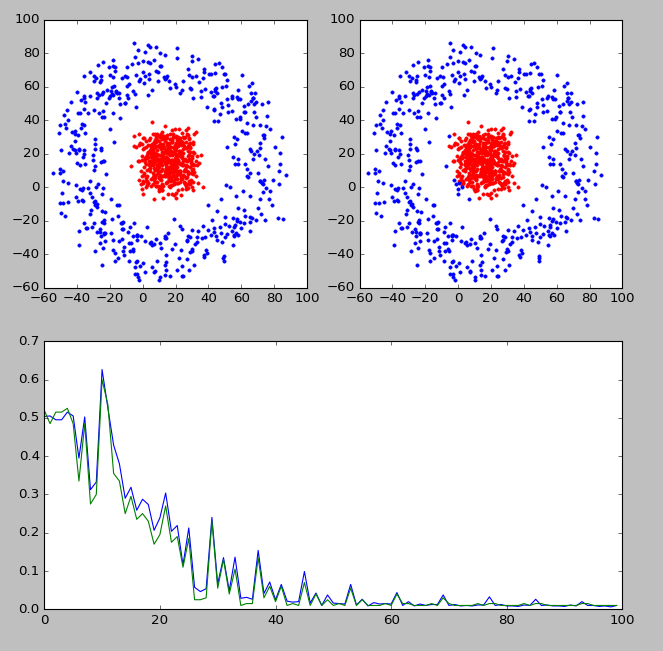
上图中,左上角显示的是实际的分类,右上角显示的是分类器判断出的各点分类。靠下的图显示的是分类器的判断准确率随迭代次数的变化情况。可以看到,经过训练以后,分类器的判断准确率还是可以的。
下面是代码部分
import numpy as np
import matplotlib.pyplot as plt
import random
import math


# 构造各个分类
def gen_sample():
    data = []
    radius = [0,50]
    for i in range(1000):  # 生成10k个点
        catg = random.randint(0,1)  # 决定分类
        r = random.random()*10
        arg = random.random()*360
        len = r + radius[catg]
        x_c = math.cos(math.radians(arg))*len
        y_c = math.sin(math.radians(arg))*len
        x = random.random()*30 + x_c
        y = random.random()*30 + y_c
        data.append((x,y,catg))
    return data

def plot_dots(data):
    data_asclass = [[] for i in range(2)]
    for d in data:
        data_asclass[int(d[2])].append((d[0],d[1]))
    colors = ['r.','b.','r.','b.']
    for i,d in enumerate(data_asclass):
        # print(d)
        nd = np.array(d)
        plt.plot(nd[:,0],nd[:,1],colors[i])
    plt.draw()

def train(input, output, Whx, Wyh, bh, by):
    """
    完成神经网络的训练过程
    :param input:   输入列向量, 例如 [x,y].T
    :param output:  输出列向量, 例如[0,1,0,0].T
    :param Whx:     x->h 的参数矩阵
    :param Wyh:     h->y 的参数矩阵
    :param bh:      x->h 的偏置向量
    :param by:      h->y 的偏置向量
    :return:
    """
    h_z = np.dot(Whx, input) + bh   # 线性求和
    h_a = 1/(1+np.exp(-1*h_z))      # 经过sigmoid激活函数
    y_z = np.dot(Wyh, h_a) + by
    y_a = 1/(1+np.exp(-1*y_z))
    c_y = (y_a-output)*y_a*(1-y_a)
    dWyh = np.dot(c_y, h_a.T)
    dby = c_y
    c_h = np.dot(Wyh.T, c_y)*h_a*(1-h_a)
    dWhx = np.dot(c_h,input.T)
    dbh = c_h
    return dWhx,dWyh,dbh,dby,c_y

def test(train_set, test_set, Whx, Wyh, bh, by):
    train_tag = [int(x) for x in train_set[:,2]]
    test_tag = [int(x) for x in test_set[:,2]]
    train_pred = []
    test_pred = []

    for i,d in enumerate(train_set):
        input = train_set[i:i+1,0:2].T
        tag = predict(input,Whx,Wyh,bh,by)
        train_pred.append(tag)
    for i,d in enumerate(test_set):
        input = test_set[i:i+1,0:2].T
        tag = predict(input,Whx,Wyh,bh,by)
        test_pred.append(tag)
    # print(train_tag)
    # print(train_pred)
    train_err = 0
    test_err = 0
    for i in range(train_pred.__len__()):
        if train_pred[i]!=int(train_tag[i]):
            train_err += 1
    for i in range(test_pred.__len__()):
        if test_pred[i]!=int(test_tag[i]):
            test_err += 1
    # print(test_tag)
    # print(test_pred)
    train_ratio = train_err / train_pred.__len__()
    test_ratio = test_err / test_pred.__len__()
    return train_err,train_ratio,test_err,test_ratio

def predict(input,Whx,Wyh,bh,by):
    # print('-----------------')
    # print(input)
    h_z = np.dot(Whx, input) + bh   # 线性求和
    h_a = 1/(1+np.exp(-1*h_z))      # 经过sigmoid激活函数
    y_z = np.dot(Wyh, h_a) + by
    y_a = 1/(1+np.exp(-1*y_z))
    # print(y_a)
    tag = np.argmax(y_a)
    return tag


if __name__=='__main__':
    input_dim   = 2
    output_dim  = 2
    hidden_size = 200
    Whx = np.random.randn(hidden_size, input_dim)*0.01
    Wyh = np.random.randn(output_dim, hidden_size)*0.01
    bh  = np.zeros((hidden_size, 1))
    by  = np.zeros((output_dim, 1))
    data = gen_sample()
    plt.subplot(221)
    plot_dots(data)
    ndata = np.array(data)
    train_set = ndata[0:800,:]
    test_set = ndata[800:1000,:]
    train_ratio_list = []
    test_ratio_list = []
    for times in range(10000):
        i = times%train_set.__len__()
        input = train_set[i:i+1,0:2].T
        tag = int(train_set[i,2])
        output = np.zeros((2,1))
        output[tag,0] = 1
        dWhx,dWyh,dbh,dby,c_y = train(input,output,Whx,Wyh,bh,by)
        if times%100==0:
            train_err,train_ratio,test_err,test_ratio = test(train_set,test_set,Whx,Wyh,bh,by)
            print('times:{t}\t train ratio:{tar}\t test ratio: {ter}'.format(tar=train_ratio,ter=test_ratio,t=times))
            train_ratio_list.append(train_ratio)
            test_ratio_list.append(test_ratio)

        for param, dparam in zip([Whx, Wyh, bh, by],
                                 [dWhx,dWyh,dbh,dby]):
            param -= 0.01*dparam
    for i,d in enumerate(ndata):
        input = ndata[i:i+1,0:2].T
        tag = predict(input,Whx,Wyh,bh,by)
        ndata[i,2] = tag
    plt.subplot(222)
    plot_dots(ndata)
    # plt.figure()
    plt.subplot(212)
    plt.plot(train_ratio_list)
    plt.plot(test_ratio_list)
    plt.show()

CSDN联合极客时间,共同打造面向开发者的精品内容学习社区,助力成长!
更多推荐

 10
10 0
0- 0


 已为社区贡献6条内容

所有评论(0)