Mybatis框架学习(基于狂神的讲解)
MyBatis环境:JDK1.8Mysql5.7Maven3.6.1IDEA回顾:JDBCMysqlJava基础MavenJunitSSM框架:配置文件的。最好的方式:看官网文档1、简介1.1什么是MyBatis官网(有时候可能需要翻墙):https://mybatis.org/mybatis-3/zh/index.htmlMyBatis 是一款优秀的持久层框架(Dao层)它支持自定义 SQL、存
MyBatis
环境:
- JDK1.8
- Mysql5.7
- Maven3.6.1
- IDEA
回顾:
- JDBC
- Mysql
- Java基础
- Maven
- Junit
SSM框架:配置文件的。最好的方式:看官网文档
1、简介
1.1什么是MyBatis
官网(有时候可能需要翻墙):https://mybatis.org/mybatis-3/zh/index.html
- MyBatis 是一款优秀的持久层框架(Dao层)
- 它支持自定义 SQL、存储过程以及高级映射。
- MyBatis 免除了几乎所有的 JDBC 代码以及设置参数和获取结果集的工作。
- MyBatis 可以通过简单的 XML 或注解来配置和映射原始类型、接口和 Java POJO(Plain Old Java Objects,普通老式 Java 对象)为数据库中的记录。
- MyBatis 本是apache的一个开源项目iBatis, 2010年这个项目由apache software foundation 迁移到了[google code](https://baike.baidu.com/item/google code/2346604),并且改名为MyBatis 。
- 2013年11月迁移到Github。
如何获得Mybatis?
-
maven仓库
<!-- https://mvnrepository.com/artifact/org.mybatis/mybatis --> <dependency> <groupId>org.mybatis</groupId> <artifactId>mybatis</artifactId> <version>3.5.2</version> </dependency> -
Github:
1.2、持久化
数据持久化
- 持久化就是将程序的数据在持久状态和瞬时状态转化的过程
- 内存:断电即失
- 数据库(JDBC),IO文件持久化
- 生活中:冷藏(冰箱),罐头
为什么需要持久化?
- 有一些对象,不能让他们丢掉(比如会员账号,银行账户金额等重要信息)
- 内存太贵了
1.3、持久层
Dao层,Service层,Controller层
- 完成持久化工作的代码块
- 层的界限十分明显
1.4、为什么需要Mybatis?
- 帮助程序员将数据存储到数据库中
- 方便
- 传统的JDBC代码太复杂了。简化。框架。自动化
- 不用Mybatis也可以。更容易上手。技术没有高低之分
- 优点:
- 简单易学
- 灵活。
- 解除sql与程序代码的耦合
- 提供映射标签,支持对象与数据库的orm字段关系映射
- 提供对象关系映射标签,支持对象关系组建维护
- 提供xml标签,支持编写动态sql
最重要的一点:使用的人多!
Spring SpringMVC SpringBoot SpringCloud
2、第一个Mybatis程序
思路:搭建环境–>导入Mybatis–>编写代码–>测试!
2.1、搭建环境
搭建数据库(使用工具是navicat)
mysql> create database mybatis;
Query OK, 1 row affected
mysql> use mybatis;
Database changed
mysql> create table user(
    -> id int(20) not null primary key,
    -> name varchar(30) default null,
    -> pwd varchar(30) default null
    -> )engine=innodb default charset=utf8;
Query OK, 0 rows affected
mysql> insert into user(id,name,pwd) values
    -> (1,'发发','125555'),
    -> (2,'聪聪','124444'),
    -> (3,'可爱发','123333');
Query OK, 3 rows affected
Records: 3  Duplicates: 0  Warnings: 0
新建项目
-
新建一个maven项目(普通的Maven项目,不用选任何模板)
-
删除src目录
-
导入Maven依赖
<!--父工程-->
<groupId>com.fafa</groupId>
<artifactId>Mybatis-Study</artifactId>
<version>1.0-SNAPSHOT</version>

<!--导入依赖-->
<dependencies>
    <!--mysql驱动-->
    <dependency>
        <groupId>mysql</groupId>
        <artifactId>mysql-connector-java</artifactId>
        <version>5.1.47</version>
    </dependency>
    <!--mybatis-->
    <!-- https://mvnrepository.com/artifact/org.mybatis/mybatis -->
    <dependency>
        <groupId>org.mybatis</groupId>
        <artifactId>mybatis</artifactId>
        <version>3.5.2</version>
    </dependency>
    <!--junit-->
    <dependency>
        <groupId>junit</groupId>
        <artifactId>junit</artifactId>
        <version>4.12</version>
    </dependency>
</dependencies>
2.2、创建一个模块
-
编写mybatis核心配置文件
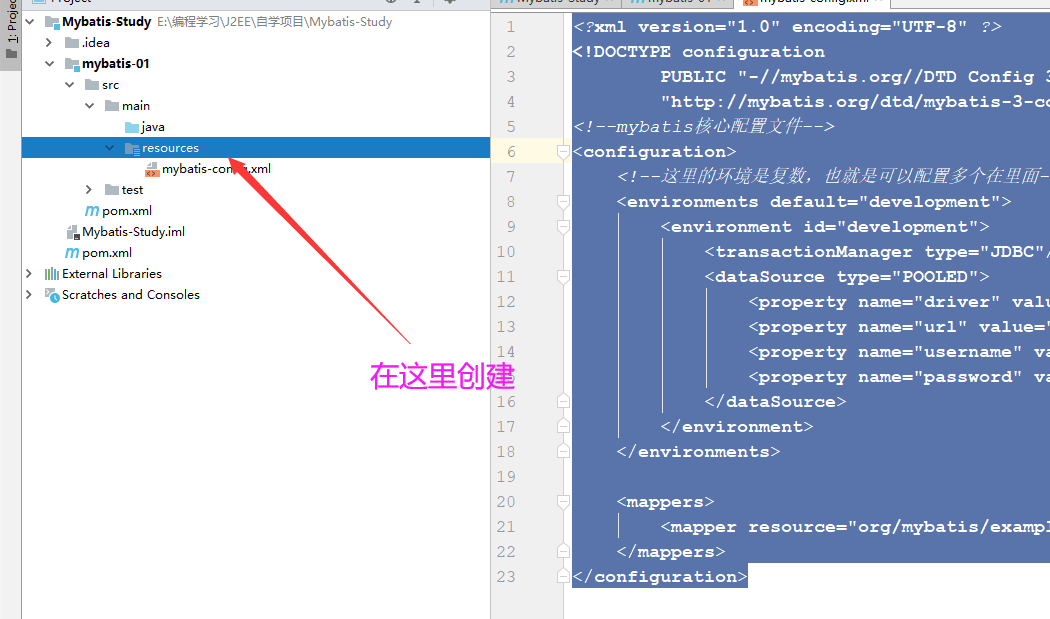
<?xml version="1.0" encoding="UTF-8" ?> <!DOCTYPE configuration PUBLIC "-//mybatis.org//DTD Config 3.0//EN" "http://mybatis.org/dtd/mybatis-3-config.dtd"> <!--mybatis核心配置文件--> <configuration> <!--这里的环境是复数,也就是可以配置多个在里面--> <environments default="development"> <environment id="development"> <transactionManager type="JDBC"/> <dataSource type="POOLED"> <property name="driver" value="com.mysql.jdbc.Driver"/> <property name="url" value="jdbc:mysql://localhost:3306/mybatis?useSSL=false&useUnicode=true&characterEncoding=utf-8"/> <property name="username" value="root"/> <property name="password" value="root"/> </dataSource> </environment> </environments> <mappers> <mapper resource="org/mybatis/example/BlogMapper.xml"/> </mappers> </configuration> -
编写Mybatis工具类
//SqlSessionFactory -- > sqlSession
public class MybatisUtils {
    //使用全局变量
    private static SqlSessionFactory sqlSessionFactory;
    static {
        try {
            //使用Mybatis第一步,获取sqlSessionFactory对象
            String resourse = "mybatis-config.xml";
            InputStream inputStream = Resources.getResourceAsStream(resourse);//注意Resources的包
            sqlSessionFactory = new SqlSessionFactoryBuilder().build(inputStream);
        } catch (IOException e) {
            e.printStackTrace();
        }
    }

    //既然有了SqlSessionFactory,顾名思义,我们就可以从中获取SqlSession的实例了
    // SqlSession 完全包含了面向数据库执行 SQL 命令的所 有方法
    public static SqlSession getSqlSession(){
        return sqlSessionFactory.openSession();
    }
}
2.3、编写代码
-
实体类
public class User { private int id; private String name; private String pwd; public User(int id, String name, String pwd) { this.id = id; this.name = name; this.pwd = pwd; } public int getId() { return id; } public void setId(int id) { this.id = id; } public String getName() { return name; } public void setName(String name) { this.name = name; } public String getPwd() { return pwd; } public void setPwd(String pwd) { this.pwd = pwd; } @Override public String toString() { return "{id=" + this.getId() + ",name='" + this.getName() + "',pwd='" + this.getPwd() + "'}"; } } -
Dao接口
public interface UserDao { List<User> getUserList(); } -
接口实现类
<?xml version="1.0" encoding="UTF-8" ?>
<!DOCTYPE mapper
        PUBLIC "-//mybatis.org//DTD Mapper 3.0//EN"
        "http://mybatis.org/dtd/mybatis-3-mapper.dtd">
<!--namespace=绑定一个对应的Dao/Mapper接口 -->
<mapper namespace="com.fafa.dao.UserDao">
    <!--select查询语句-->
    <select id="getUserList" resultType="com.fafa.pojo.User">
        select * from mybatis.user;
    </select>

</mapper>
2.4、测试(Junit)
注意点:org.apache.ibatis.binding.BindingException: Type interface com.fafa.dao.UserDao is not known to the MapperRegistry.
意思是Mapper未注册
解决方法:再Mapper的配置文件中加入这个
<!--注册Mapper的
        每一个Mapper.xml都需要在Mybatis核心配置文件中注册
-->
<mappers>
        <mapper resource="org/mybatis/example/BlogMapper.xml"/>
</mappers>
-
Junit测试
这里建议和java文件夹里的目录层次保持一致
[外链图片转存失败,源站可能有防盗链机制,建议将图片保存下来直接上传(img-i9MY8Wu4-1627047348794)(https://raw.githubusercontent.com/keaifafafa/IO/master/img/pic/20210723212614.png)]
public class UserDaoTest {
    @Test
    public void Test(){
        //获取SqlSession对象   静态方法是类 同时 加载的
        SqlSession sqlSession = null;
        try{
            sqlSession = MybatisUtils.getSqlSession();
            //方式一(推荐)   获取Dao/Mapper层对象  并进行查询操作
            UserDao mapper = sqlSession.getMapper(UserDao.class);
            List<User> userList = mapper.getUserList();

            //方式二  了解即可
            /*List<User> userList = sqlSession.selectList("com.fafa.dao.UserDao.getUserList");*/

            //对返回的结果进行遍历
            for (User user : userList) {
                System.out.println(user.toString());
            }
        }catch(Exception e){
            System.out.println("捕捉到异常!");
        }finally {
            //关闭资源  防止内存溢出
            sqlSession.close();
        }

    }
}
解决问题及总结
当完成上面的步骤后发现还是有错误
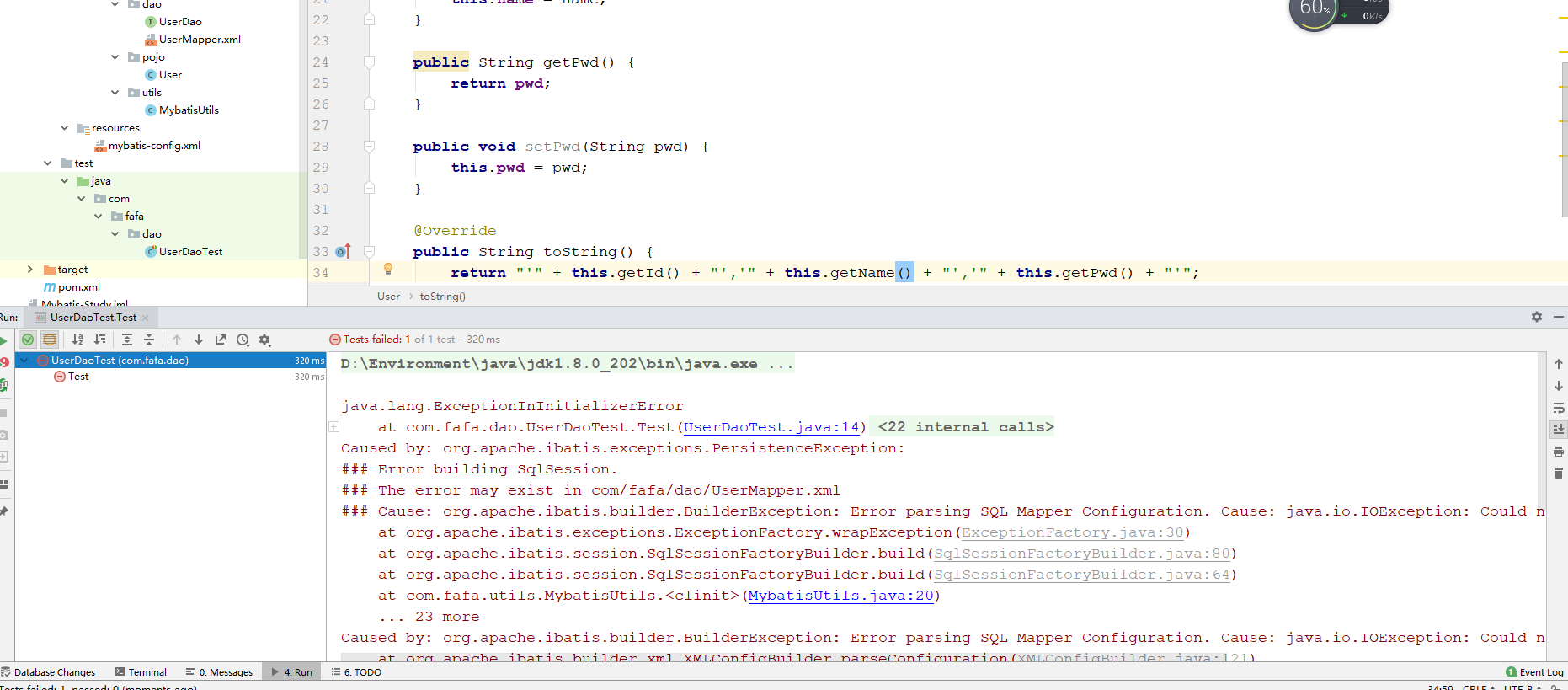
这个错误是Maven的问题,记得前面在javaweb的时候就说过,maven的约定大于配置的问题
解决方案有两种
-
第一种(很麻烦,不推荐)
-
第二种 在父工程的pom.xml和子工程的pom.xml中添加这样一段Java代码
<!--在build中配置resources,来防止我们资源导出失败的问题-->
<build>
    <resources>
        <resource>
            <directory>src/main/resources</directory>
            <includes>
                <include>**/*.properties</include>
                <include>**/*.xml</include>
            </includes>
            <filtering>true</filtering>
        </resource>
        <resource>
            <directory>src/main/java</directory>
            <includes>
                <include>**/*.properties</include>
                <include>**/*.xml</include>
            </includes>
            <filtering>true</filtering>
        </resource>
    </resources>
</build>
3、CRUD(增删改查)
3.1、namespace
namespace中的包名要和Dao/Mapper接口的包名字保持一致
3.2、select
选择,查询语句;
- id:就是对应namespace中的方法名
- resultType:sql语句执行的返回值
- parameterType:参数类型
-
编写接口
//查询全部用户信息 List<User> getUserList(); -
编写对应的mapper中的sql语句
<!--select查询语句--> <select id="getUserList" resultType="com.fafa.pojo.User"> select * from mybatis.user; </select> -
测试
//查询全部用户
@Test
public void Test(){
    //获取SqlSession对象   静态方法是类 同时 加载的
    SqlSession sqlSession = null;
    try{
        sqlSession = MybatisUtils.getSqlSession();
        //方式一(推荐)   获取Dao/Mapper层对象  并进行查询操作
        UserMapper mapper = sqlSession.getMapper(UserMapper.class);
        List<User> userList = mapper.getUserList();

        //方式二  了解即可
        /*List<User> userList = sqlSession.selectList("com.fafa.dao.UserDao.getUserList");*/

        //对返回的结果进行遍历
        for (User user : userList) {
            System.out.println(user);
        }
    }catch(Exception e){
        System.out.println("捕捉到异常!");
    }finally {
        //关闭资源  防止内存溢出
        sqlSession.close();
    }
}
3.3、insert
<!--插入用户-->
<insert id="addUser" parameterType="com.fafa.pojo.User">
    insert into mybatis.user(id,name,pwd) values (#{id},#{name},#{pwd});
</insert>
3.4、update
<!--更新用户信息
    里面的sql语句都不用加""  字符串也不要加 不然报错
    -->
<update id="updateUser" parameterType="com.fafa.pojo.User">
    update mybatis.user set name=#{name},pwd=#{pwd} where id=#{id};
</update>
3.5、delete
<!--删除用户-->
<delete id="deleteUser" parameterType="int">
    delete from mybatis.user where id=#{id};
</delete>
3.6、万能的Map
假设,我们的实体类,或者数据库中的表,字段或者参数过多,我们应该考虑使用Map!
-
UserMapper接口
//用万能Map插入用户 public void addUser2(Map<String,Object> map); -
UserMapper.xml
<!--对象中的属性可以直接取出来 传递map的key--> <insert id="addUser2" parameterType="map"> insert into user (id,name,password) values (#{userid},#{username},#{userpassword}) </insert> -
测试
@Test
public void test3(){
    SqlSession sqlSession = MybatisUtils.getSqlSession();
    UserMapper mapper = sqlSession.getMapper(UserMapper.class);
    HashMap<String, Object> map = new HashMap<String, Object>();
    map.put("userid",4);
    map.put("username","王虎");
    map.put("userpassword",789);
    mapper.addUser2(map);
    //提交事务
    sqlSession.commit();
    //关闭资源
    sqlSession.close();
}
Map传递参数,直接在sql中取出key即可! 【parameter=“map”】
对象传递参数,直接在sql中取出对象的属性即可! 【parameter=“Object”】
只有一个基本类型参数的情况下,可以直接在sql中提取到!
多个参数用Map,或者注解!
3.7、模糊查询
模糊查询这么写?
- Java代码执行的时候,传递通配符% %
List<User> userList = mapper.getUserLike("%李%");
- 在sql拼接中使用通配符
select * from user where name like "%"#{value}"%"
4、配置解析
4.1、核心配置文件
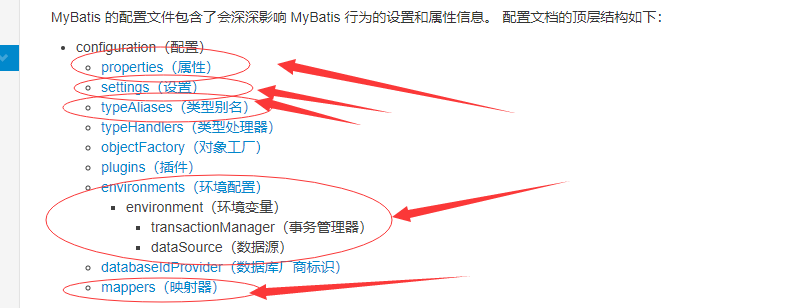
- mybatis-config.xml
- Mybatis的配置文件包含了会深深影响Mybatis行为的设置和属性信息
4.2、环境配置 environments
mybatis 可以配置成适应多种环境
不过要记住:尽管可以配置成多个环境,但是每个SQLSessionFactory实例只能选择一种环境
学会使用配置多套运行环境!
Mybatis默认的事务管理器就是JDBC,连接池:POOLED
4.3、属性properties
我们可以通过properties属性来实现引用配置文件
这些属性可以在外部进行配置,并可以进行动态替换。你既可以在典型的 Java 属性文件中配置这些属性,也可以在 properties 元素的子元素中设置。【db.properties】
-
编写一个配置文件
db.properties
driver=com.mysql.jdbc.Driver url=jdbc:mysql://localhost:3306/mybatis?useSSL=false&useUnicode=true&characterEncoding=utf-8 username=root password=root -
在核心配置文件中引入
<!--引入外部资源--> <properties resource="db.properties"/>- 可以直接引入外部文件
- 可以在其中增加一些属性配置
- 如果两个文件里有同一个字段,优先使用外部配置文件的
4.4、类别名 typeAliases
-
类别名可为Java类型设置一个缩写字段名字。它仅适用于XML配置
-
意在降低冗余的完全限定类名书写
<!--给实体类取别名-->
<typeAliases>
    <typeAlias type="com.fafa.pojo.User" alias="User"/>
</typeAliases>
也可以指定一个包,每一个在包
domain.blog中的 Java Bean,在没有注解的情况下,会使用 Bean 的首字母小写的非限定类名来作为它的别名。 比如domain.blog.Author的别名为author,;若有注解,则别名为其注解值。见下面的例子:<typeAliases> <package name="com.fafa.pojo"/> </typeAliases>在实体类比较少的时候,使用第一种方式。
如果实体类十分多,建议用第二种扫描包的方式。
第一种可以DIY别名,第二种不行,如果非要改,需要在实体上增加注解
@Alias("author")
public class Author {
    ...
}
4.5、设置 Settings
这是Mybatis中极为重要的调整设置,他们会改变Mybatis的运行时行为。

4.6、其他配置
- typeHandlers(类型处理器)
- objectFactory(对象工厂)
- plugins 插件
- mybatis-generator-core
- mybatis-plus
- 通用mapper
4.7、映射器 mappers
MapperRegistry:注册绑定我们的Mapper文件;
方式一:【推荐使用】
<!--每一个Mapper.xml都需要在MyBatis核心配置文件中注册-->
<mappers>
    <mapper resource="com/fafa/dao/UserMapper.xml"/>
</mappers>
方式二:使用class文件绑定注册
<!--每一个Mapper.xml都需要在MyBatis核心配置文件中注册-->
<mappers>
    <mapper class="com.fafa.dao.UserMapper"/>
</mappers>
注意点:
- 接口和他的Mapper配置文件必须同名
- 接口和他的Mapper配置文件必须在同一个包下
方式三:使用包扫描进行注入
<mappers>
    <package name="com.fafa.dao"/>
</mappers>
4.8、生命周期和作用域
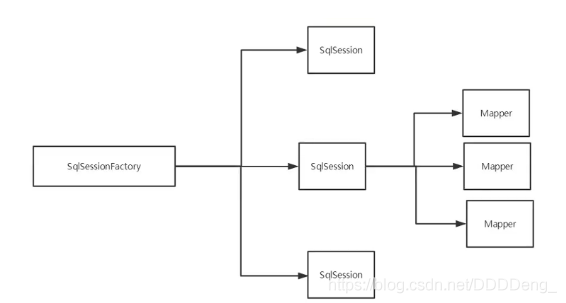
声明周期和作用域是至关重要的,因为错误的使用会导致非常严重的并发问题。
SqlSessionFactoryBuilder:
- 一旦创建了SqlSessionFactory,就不再需要他了
- 局部变量
SqlSessionFactory:
- 说白了可以想象为:数据库连接池
- SqlSessionFactory一旦被创建就应该在应用的运行期间一直存在,没有任何理由丢弃它或者重新创建一个实例。
- 因此SqlSessionFactory的最佳作用域是应用作用域(ApplicationContext)
- 最简单的就是使用单例模式或者静态单例模式
SqlSession:
-
连接到连接池的一个请求
-
SqlSession的实例不是线程安全的,因此是不能共享的,所以他的最佳的作用域是请求或者方法作用域
-
用完之后需要赶紧关闭,否则资源被占用。
5、解决属性名和字段名不一致的问题
5.1、问题
数据库的字段
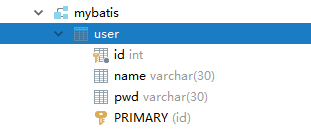
新建一个项目,拷贝之前的,测试实体类字段不一致的情况
public class User {
    private int id;
    private String name;
    private String password;
    //无参构造
    public User() {

    }

    //含参构造
    public User(int id, String name, String password) {
        this.id = id;
        this.name = name;
        this.password = password;
    }


    @Override
    public String toString() {
        return "User{" +
            "id=" + id +
            ",name='" + name + '\'' +
            "',password='" + password + '\'' +
            '}';
    }
}
测试出现问题(password的值为null)

//select * from mybatis.user where id = #{id};
//类处理器
//select id,name,pwd from mybatis.user where id = #{id};
//类处理器是很笨的,不晓得变通,pwd和password不一致  上面的两句sql语句相等
解决方法:
-
起别名(最基本的,很low)
<!--查询单个用户信息-->
<select id="getUserById" parameterType="_int" resultType="User">
    select id,name,pwd as password from mybatis.user where id = #{id};
</select>
5.2、ResultMap
结果集映射
id name pwd
id name password
<!--结果集映射-->
<resultMap id="resultMap" type="User">
    <!--
        column是数据库的字段
        property是实例类中的属性
        两者一一对应,形成映射关系
        -->
    <result column="id" property="id"/>
    <result column="name" property="name"/>
    <result column="pwd" property="password"/>
</resultMap>
<!--查询单个用户信息-->
<select id="getUserById" resultMap="resultMap">
    select * from mybatis.user where id = #{id};
</select>
[外链图片转存失败,源站可能有防盗链机制,建议将图片保存下来直接上传(img-GiKqxPEF-1627047348811)(https://raw.githubusercontent.com/keaifafafa/IO/master/img/pic/20210723212850.png)]
- resultMap元素是Mybatis中最重要最强大的元素
- ResultMap的设计思想是,对于简单的语句做到零配置,对于复杂一点的语句,只需要描述语句之间的关系就行了
- ResultMap的优秀之处——在你做够了解他之后,你完全可以不用显示的配置他们
- 如果这个时间总是这么简单就好了。
6、日志
6.1、日志工厂
如果一个数据库操作出现了异常,我们需要排错。日志就是最好的助手。
曾经:sout,debug
现在:日志工厂

- SLF4J
- LOG4J (掌握)
- LOG4J2
- JDK_LOGGING
- COMMONS_LOGGING
- STDOUT_LOGGING(掌握)
- NO_LOGGING
使用方法:
严格按照顺序添加
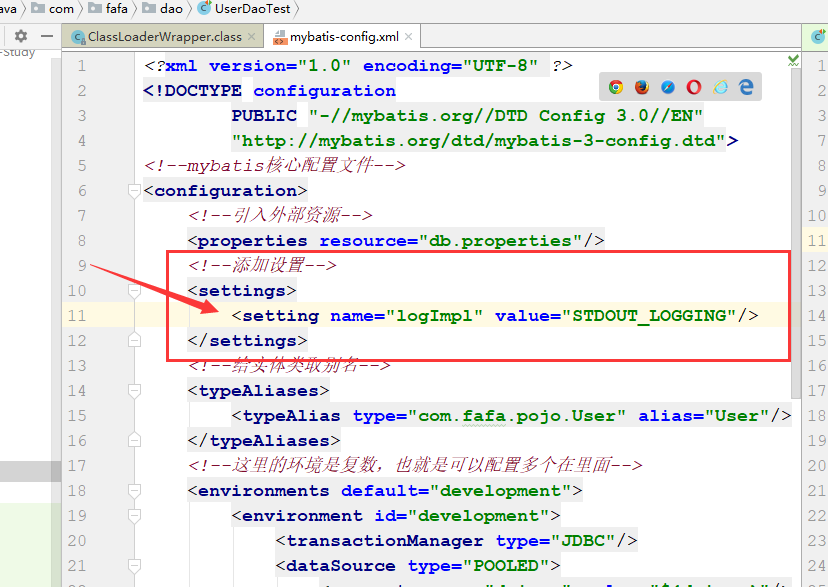
运行结果:
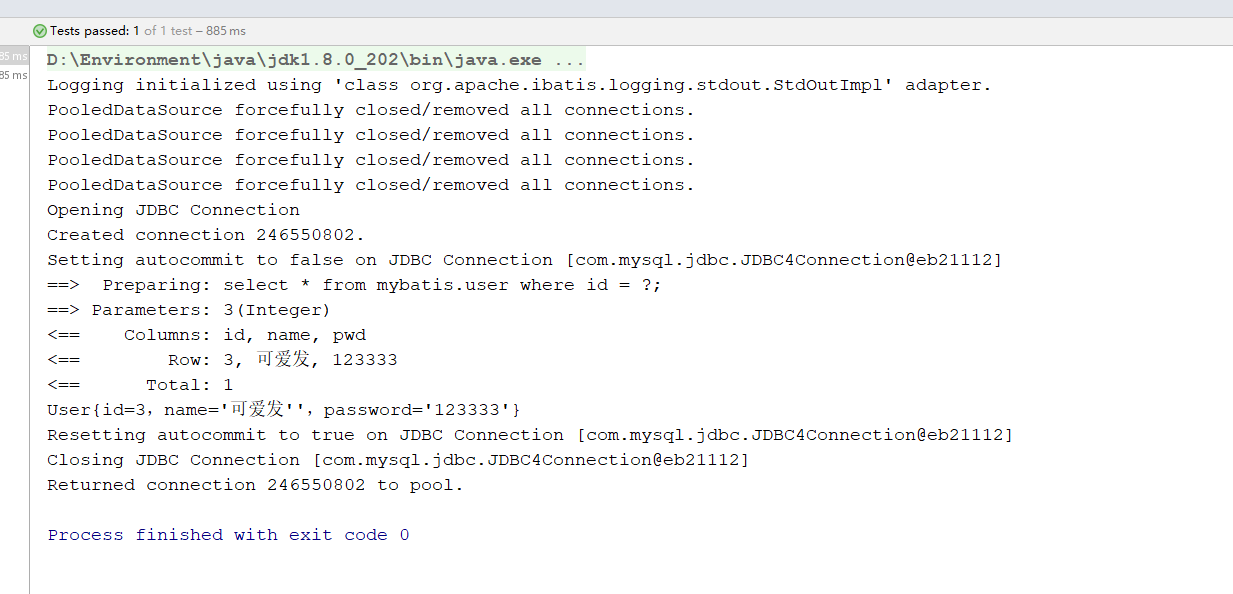
6.2、LOG4J
什么是Log4j?
- Log4j是Apache的一个开源项目,通过使用Log4j,我们可以控制日志信息输送的目的地是控制台、文件、GUI组件;
- 我们也可以控制每一条日志的输出格式;
- 通过定义每一条日志信息的级别,我们能够更加细致地控制日志的生成过程;
- 最令人感兴趣的就是,这些可以通过一个配置文件来灵活地进行配置,而不需要修改应用的代码。
-
先导入log4j的包
<dependency> <groupId>log4j</groupId> <artifactId>log4j</artifactId> <version>1.2.17</version> </dependency> -
log4j.properties(名字一定要是这个,不然找不到)
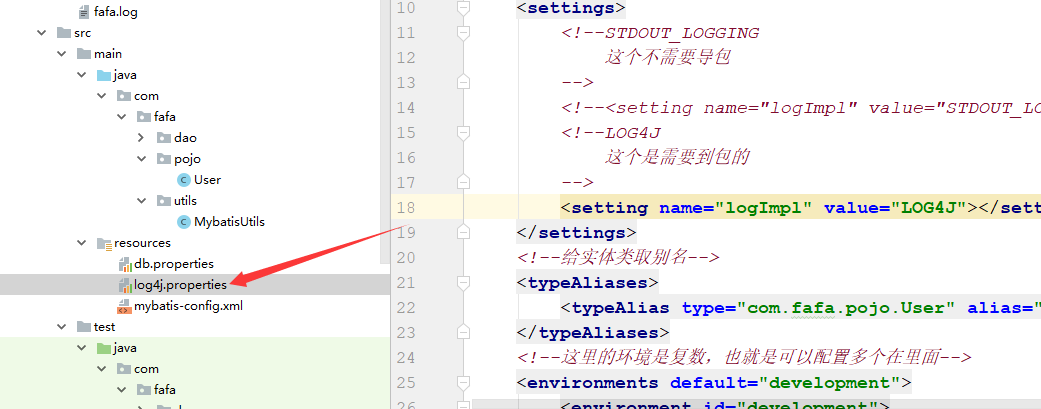
log4j.rootLogger=DEBUG,console,file #控制台输出的相关设置 log4j.appender.console = org.apache.log4j.ConsoleAppender log4j.appender.console.Target = System.out log4j.appender.console.Threshold=DEBUG log4j.appender.console.layout = org.apache.log4j.PatternLayout log4j.appender.console.layout.ConversionPattern=[%c]-%m%n #文件输出的相关设置 log4j.appender.file = org.apache.log4j.RollingFileAppender log4j.appender.file.File=./log/fafa.log log4j.appender.file.MaxFileSize=10mb log4j.appender.file.Threshold=DEBUG log4j.appender.file.layout=org.apache.log4j.PatternLayout log4j.appender.file.layout.ConversionPattern=[%p][%d{yy-MM-dd}][%c]%m%n #日志输出级别 log4j.logger.org.mybatis=DEBUG log4j.logger.java.sql=DEBUG log4j.logger.java.sql.Statement=DEBUG log4j.logger.java.sql.ResultSet=DEBUG log4j.logger.java.sql.PreparedStatement=DEBUG -
配置settings为log4j实现
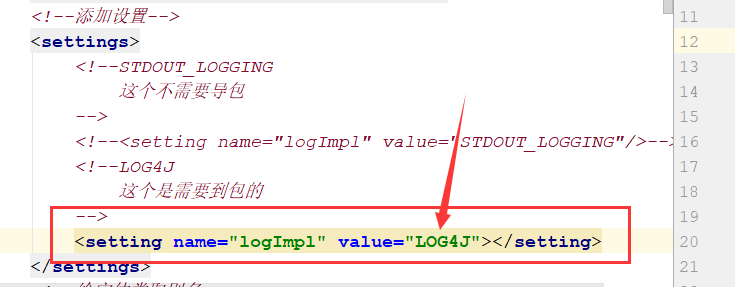
-
测试运行
Log4j简单使用
-
在要使用Log4j的类中,导入包 import org.apache.log4j.Logger;
-
日志对象,参数为当前类的class对象
private static Logger logger = Logger.getLogger(UserMapper.class); -
日志级别
logger.info("Info:成功进入testLog4j()!"); logger.debug("Debug:成功进入testLog4j()!"); logger.error("Error:成功进入testLog4j()!");- info
- debug
- error
7、分页
思考:为什么要使用分页?
- 减少数据的使用量
7.1、使用Limit分页(掌握)
SELECT * from user limit startIndex,pageSize;
使用Mybatis实现分页,核心SQL
-
接口
//分页查询用户 像这种多个参数的就推荐使用map List<User> getUserByLimit(Map<String,Integer> map); -
Mapper.xml 文件
<!--分页查询 方式一-->
<select id="getUserByLimit" parameterType="map" resultMap="UserMap">
    select * from mybatis.user limit #{startIndex},#{pageSize};
</select>
-
测试
//测试分页功能(方式一)
@Test
public void testGetUserByLimit(){
    SqlSession sqlSession = MybatisUtils.getSqlSession();
    UserMapper mapper = sqlSession.getMapper(UserMapper.class);
    Map<String, Integer> map = new HashMap<String, Integer>();
    map.put("startIndex",0);//开始的页码下标
    map.put("pageSize",3);//每页的大小
    List<User> userByLimit = mapper.getUserByLimit(map);
    for (User user : userByLimit) {
        System.out.println(user);
    }
    sqlSession.close();

}
7.2、RowBounds(了解)
目的:
为了体现java的面向对象思想,不再使用Sql实现分页
-
接口
//分页方式二(RowBounds 了解即可) List<User> getUserByRowBounds(); -
Mapper.xml 文件
<!--分页查询 RowBounds方式 了解即可--> <select id="getUserByRowBounds" resultMap="UserMap"> select * from mybatis.user; </select> -
测试
//测试分页(方式二 RowBounds)
@Test
public void testLimitByRowRounds(){
    SqlSession sqlSession = MybatisUtils.getSqlSession();
    RowBounds rowBounds = new RowBounds(1,2);
    List<User> userList = sqlSession.selectList("com.fafa.dao.UserMapper.getUserByRowBounds", null, rowBounds);
    for (User user : userList) {
        System.out.println(user);
    }
    sqlSession.close();
}
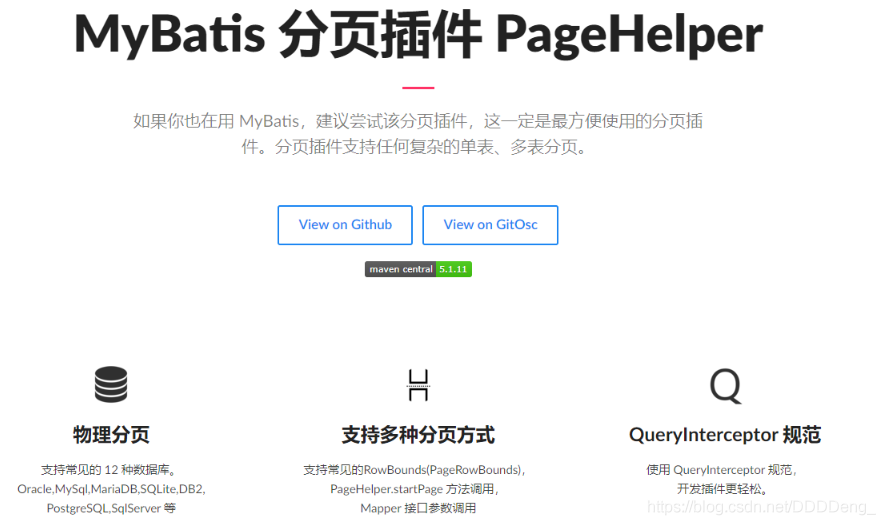
7.3、分页插件(了解)
8、使用注解开发
8.1、面向接口开发
-
大家之前都学过面向对象编程,也学习过接口,但在真正的开发中,很多时候我们会选择面向接口编程
-
根本原因 : 解耦 , 可拓展 , 提高复用 , 分层开发中 , 上层不用管具体的实现 , 大家都遵守共同的标准 , 使得开发变得容易 , 规范性更好
-
在一个面向对象的系统中,系统的各种功能是由许许多多的不同对象协作完成的。在这种情况下,各个对象内部是如何实现自己的,对系统设计人员来讲就不那么重要了;
-
而各个对象之间的协作关系则成为系统设计的关键。小到不同类之间的通信,大到各模块之间的交互,在系统设计之初都是要着重考虑的,这也是系统设计的主要工作内容。面向接口编程就是指按照这种思想来编程。
8.2、利用注解开发
- mybatis最初配置信息是基于 XML ,映射语句(SQL)也是定义在 XML 中的。而到MyBatis 3提供了新的基于注解的配置。不幸的是,Java 注解的的表达力和灵活性十分有限。最强大的 MyBatis 映射并不能用注解来构建
- sql 类型主要分成 :
@select ()@update ()@Insert ()@delete ()
注意:利用注解开发就不需要mapper.xml映射文件了 .
1、我们在我们的接口中添加注解
//查询全部用户
@Select("select id,name,pwd password from user")
public List<User> getAllUser();
2、在mybatis的核心配置文件中注入
<!--使用class绑定接口-->
<mappers>
    <mapper class="com.kuang.mapper.UserMapper"/>
</mappers>
3、我们去进行测试
@Test
public void testGetAllUser() {
    SqlSession session = MybatisUtils.getSession();
    //本质上利用了jvm的动态代理机制
    UserMapper mapper = session.getMapper(UserMapper.class);

    List<User> users = mapper.getAllUser();
    for (User user : users){
        System.out.println(user);
    }

    session.close();
}
4、利用Debug查看本质
接口 === 架构(骨头)
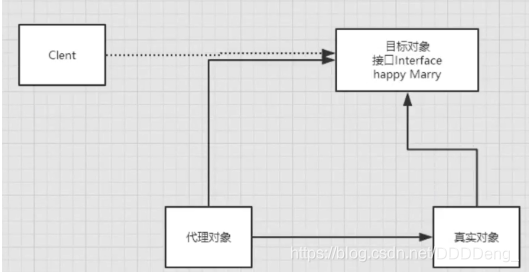
注解开发:本质是主要运用反射机制
底层:动态代理模式(多线程里面讲过)
5、本质上利用了jvm的动态代理机制
6、Mybatis详细的执行流程
8.3、注解方式实现CRUD
//方法存在多个参数,所有的参数前面必须加上@Param("id")注解
@Delete("delete from user where id = ${uid}")
int deleteUser(@Param("uid") int id);
关于@Param( )注解
- 基本类型的参数或者String类型,需要加上
- 引用类型不需要加
- 如果只有一个基本类型的话,可以忽略,但是建议大家都加上
- 我们在SQL中引用的就是我们这里的@Param()中设定的属性名
#{}可以防止SQl注入,${}不可以
使用注解和配置文件协同开发,才是MyBatis的最佳实践!
使用注解开发可以提高我们的开发效率,可以合理使用哦!
9、Lombok的使用
Lombok项目是一个Java库,它会自动插入编辑器和构建工具中,Lombok提供了一组有用的注释,用来消除Java类中的大量样板代码。仅五个字符(@Data)就可以替换数百行代码从而产生干净,简洁且易于维护的Java类。
使用步骤:
-
在IDEA中安装Lombok插件
-
在项目中导入lombok的jar包
<!-- https://mvnrepository.com/artifact/org.projectlombok/lombok --> <dependency> <groupId>org.projectlombok</groupId> <artifactId>lombok</artifactId> <version>1.18.12</version> <scope>provided</scope> </dependency> -
在程序上加注解
@Getter and @Setter
@FieldNameConstants
@ToString
@EqualsAndHashCode
@AllArgsConstructor, @RequiredArgsConstructor and @NoArgsConstructor
@Log, @Log4j, @Log4j2, @Slf4j, @XSlf4j, @CommonsLog, @JBossLog, @Flogger, @CustomLog
@Data
@Builder
@SuperBuilder
@Singular
@Delegate
@Value
@Accessors
@Wither
@With
@SneakyThrows
@val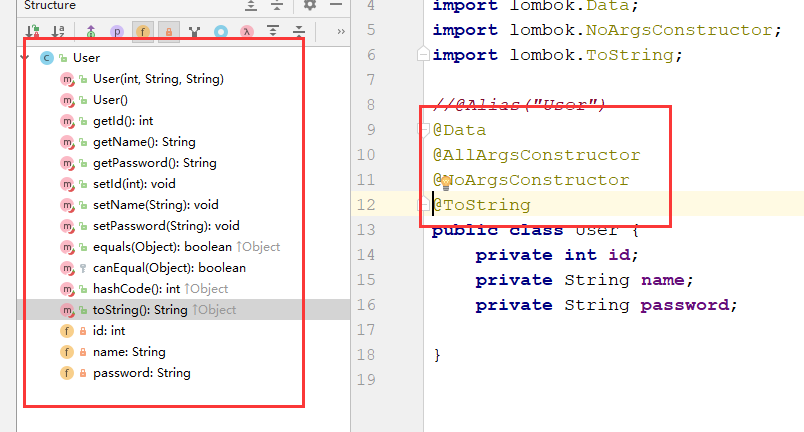
10、多对一的处理
多个学生对应一个老师;
alter table student ADD CONSTRAINT fk_tid foreign key (tid) references teacher(id)
10.1、搭建测试环境
相关mysql语句
CREATE TABLE `teacher` (
  `id` INT(10) NOT NULL,
  `name` VARCHAR(30) DEFAULT NULL,
  PRIMARY KEY (`id`)
) ENGINE=INNODB DEFAULT CHARSET=utf8;

INSERT INTO teacher(`id`, `name`) VALUES (1,'杨老师');

CREATE TABLE `student` (
  `id` INT(10) NOT NULL,
  `name` VARCHAR(30) DEFAULT NULL,
  `tid` INT(10) DEFAULT NULL,
  PRIMARY KEY (`id`),
  KEY `fktid` (`tid`),
  CONSTRAINT `fktid` FOREIGN KEY (`tid`) REFERENCES `teacher` (`id`)
) ENGINE=INNODB DEFAULT CHARSET=utf8;

INSERT INTO `student` (`id`, `name`, `tid`) VALUES (1, '小明', 1);
INSERT INTO `student` (`id`, `name`, `tid`) VALUES (2, '小红', 1);
INSERT INTO `student` (`id`, `name`, `tid`) VALUES (3, '小张', 1);
INSERT INTO `student` (`id`, `name`, `tid`) VALUES (4, '小李', 1);
INSERT INTO `student` (`id`, `name`, `tid`) VALUES (5, '小王', 1);
- 导入lombok
- 新建实体类Teacher,Student
- 建立Mapper接口
- 建立Mapper.xml文件
- 在核心配置文件中绑定注册我们的Mapper接口或者文件 【方式很多,随心选】
- 测试查询是否能够成功
10.2、按照查询嵌套处理
<!--
    思路:
    1. 查询所有的学生信息
    2. 根据查询出来的学生的tid寻找特定的老师 (子查询)
-->
<select id="getStudent" resultMap="StudentTeacher">
    select * from student
</select>
<resultMap id="StudentTeacher" type="student">
    <result property="id" column="id"/>
    <result property="name" column="name"/>
    <!--复杂的属性,我们需要单独出来 对象:association 集合:collection-->
    <association property="teacher" column="tid" javaType="teacher" select="getTeacher"/>
</resultMap>
<select id="getTeacher" resultType="teacher">
    select * from teacher where id = #{id}
</select>
10.3、按照结果嵌套处理
<!--按照结果进行查询-->
<select id="getStudent2" resultMap="StudentTeacher2">
    select s.id sid , s.name sname, t.name tname
    from student s,teacher t
    where s.tid=t.id
</select>
<!--结果封装,将查询出来的列封装到对象属性中-->
<resultMap id="StudentTeacher2" type="student">
    <result property="id" column="sid"/>
    <result property="name" column="sname"/>
    <association property="teacher" javaType="teacher">
        <result property="name" column="tname"></result>
    </association>
</resultMap>
回顾Mysql多对一查询方式:
- 子查询(按照查询嵌套)
- 联表查询(按照结果嵌套)
11、一对多
一个老师对多个学生
对于老师而言,就是一对多的关系
11.1、环境搭建
和上面那个一样
实体类
/**
 * 学生实体类
* */
@Data
@ToString
public class Student {
    private int id;
    private String name;
    private int tid;
}
/**
 * 老师实体类
 * */
@Data
@ToString
public class Teacher {
    private int id;
    private String name;
    //组合
    private List<Student> students;
}
11.2、按照结果嵌套嵌套处理
<mapper namespace="com.fafa.dao.TeacherMapper">
    <select id="getTeacherById" resultMap="TeacherStudent">
        select t.id tid,t.name tname,s.id sid,s.name sname,s.tid stid
        from student s,teacher t
        where t.id = s.tid and t.id = #{uid};
    </select>
    <resultMap id="TeacherStudent" type="Teacher">
        <result property="id" column="tid"/>
        <result property="name" column="tname"/>
        <!--
            一对多使用 collection
            多对一使用 association
        -->
        <collection property="students" ofType="student">
            <result property="id" column="sid"/>
            <result property="name" column="sname"/>
            <result property="tid" column="stid"/>
        </collection>
    </resultMap>
</mapper>
小结
- 关联 - association{多对一}
- 集合 - collection{一对多}
- JavaType & ofType
- JavaType 用来指定实体类中的类型
- ofType用来映射到List或者结合中的pojo类型,泛型中的约束类型
注意点
- 保证SQL的可读性,尽量保证通俗易懂
- 注意一对多和多对一,属性名和字段的问题
- 如果问题不好排查错误,可以使用日志,建议使用Log4j
面试必考
- Mysql引擎
- InnoDB底层原理
- 索引
- 索引优化
12、动态Sql
什么是动态SQL:动态SQL就是根据不同的条件生成不同的SQL语句
所谓的动态SQL,本质上还是SQL语句,只是我们可以在SQL层面,去执行一个逻辑代码
if
choose (when, otherwise)
trim (where, set)
foreach
12.1、搭建环境
相关SQL语句
CREATE TABLE `blog`(
    `id` VARCHAR(50) NOT NULL COMMENT 博客id,
    `title` VARCHAR(100) NOT NULL COMMENT 博客标题,
    `author` VARCHAR(30) NOT NULL COMMENT 博客作者,
    `create_time` DATETIME NOT NULL COMMENT 创建时间,
    `views` INT(30) NOT NULL COMMENT 浏览量
)ENGINE=INNODB DEFAULT CHARSET=utf8;
创建一个工程
-
导包
-
编写配置文件
-
编写实体类
/** * 博客实体类 * */ @Data @ToString public class Blog { private String id; private String title; private String author; private Date createTime; private int views; } -
编写实体类对应的Mapper接口和Mapper.xml文件
12.2、IF
需求:根据作者名字和博客名字来查询博客!如果作者名字为空,那么只根据博客名字查询,反之,则根据作者名来查询
-
编写接口类
//查询博客(If) public List<Blog> queryBlogIf(Map<String,Object> map); -
编写Sql语句
<!--需求1: 根据作者名字和博客名字来查询博客! 如果作者名字为空,那么只根据博客名字查询,反之,则根据作者名来查询 select * from blog where title = #{title} and author = #{author} --> <select id="queryBlogIf" parameterType="map" resultType="Blog"> select * from mybatis.blog where 1 = 1 <if test="author != null"> and author = #{author} </if> <if test="title != null"> and title = #{title} </if> </select> -
测试
//测试if功能
@Test
public void testIf(){
    SqlSession sqlSession = MybatisUtils.getSqlSession();
    BlogMapper mapper = sqlSession.getMapper(BlogMapper.class);
    HashMap<String, Object> map = new HashMap<String,Object>();
    //        map.put("author","可爱发");
    map.put("title","Mybatis如此简单!");
    List<Blog> blogs = mapper.queryBlogIf(map);
    for (Blog blog : blogs) {
        System.out.println(blog);
    }
    sqlSession.close();
}
12.3、choose (when, otherwise)
类似java里的Switch语句
有时候,我们不想用到所有的查询条件,只想选择其中的一个,查询条件有一个满足即可,使用 choose 标签可以解决此类问题,类似于 Java 的 switch 语句
-
编写接口方法
//查询(Choose) public List<Blog> queryBlogChoose(Map<String,Object> map); -
sql配置文件
<!-- choose语句 和java里的Switch语法类似 where会自动去掉多余的and --> <select id="queryBlogChoose" parameterType="map" resultType="Blog"> select * from mybatis.blog <where> <choose> <when test="title != null"> title = #{title} </when> <when test="author != null"> and author = #{author} </when> <otherwise> and views = #{views} </otherwise> </choose> </where> </select> -
测试类
//测试choose功能
@Test
public void testChoose(){
    SqlSession sqlSession = MybatisUtils.getSqlSession();
    BlogMapper mapper = sqlSession.getMapper(BlogMapper.class);
    HashMap<String, Object> map = new HashMap<String,Object>();
    map.put("author","可爱发");
    /*map.put("title","Mybatis如此简单!");*/
    List<Blog> blogs = mapper.queryBlogChoose(map);
    for (Blog blog : blogs) {
        System.out.println(blog);
    }
    sqlSession.close();
}
12.4、 Where&trim
修改上面的SQL语句;
<select id="queryBlogIf" parameterType="map" resultType="blog">
    select * from blog
    <where>
        <if test="title != null">
            title = #{title}
        </if>
        <if test="author != null">
            and author = #{author}
        </if>
    </where>
</select>
这个“where”标签会知道如果它包含的标签中有返回值的话,它就插入一个‘where’。此外,如果标签返回的内容是以AND 或OR 开头的,则它会剔除掉。
如果 where 元素与你期望的不太一样,你也可以通过自定义 trim 元素来定制 where 元素的功能。比如,和 where 元素等价的自定义 trim 元素为:
<trim prefix="WHERE" prefixOverrides="AND |OR ">
    ...
</trim>
12.5、Set&trim
同理,上面的对于查询 SQL 语句包含 where 关键字,如果在进行更新操作的时候,含有 set 关键词,我们怎么处理呢?
-
编写BlogMapper接口方法
//修改用户信息(trim,set) public int upDateBlog(Map<String,Object> map); -
编写BlogMapper.xml
<!--信息修改 set可以去除多余的逗号 --> <update id="upDateBlog" parameterType="map"> update mybatis.blog <set> <if test="title != null"> title = #{title}, </if> <if test="author != null"> author = #{author} </if> </set> where id = #{id} </update> -
测试
//修改数据
@Test
public void testUpdate(){
    SqlSession sqlSession = MybatisUtils.getSqlSession();
    BlogMapper mapper = sqlSession.getMapper(BlogMapper.class);
    HashMap<String, Object> map = new HashMap<String,Object>();
    map.put("author","可爱发222");
    map.put("id","cd69ad4884e545fb8cf9d8f2d0abc01f");
    /*map.put("title","Mybatis如此简单!");*/
    int i = mapper.upDateBlog(map);
    if(i > 0){
        System.out.println("Successfully!!!!");
    }
    sqlSession.close();
}
这个例子中,set 元素会动态地在行首插入 SET 关键字,并会删掉额外的逗号(这些逗号是在使用条件语句给列赋值时引入的)。
来看看与 set 元素等价的自定义 trim 元素吧:
<trim prefix="SET" suffixOverrides=",">
    ...
</trim>
注意,我们覆盖了后缀值设置,并且自定义了前缀值。
12.6、SQL片段
有时候可能某个 sql 语句我们用的特别多,为了增加代码的重用性,简化代码,我们需要将这些代码抽取出来,然后使用时直接调用。
提取SQL片段:
<sql id="if-title-author">
    <if test="title != null">
        title = #{title}
    </if>
    <if test="author != null">
        and author = #{author}
    </if>
</sql>
引用SQL片段:
<select id="queryBlogIf" parameterType="map" resultType="blog">
    select * from blog
    <where>
        <!-- 引用 sql 片段,如果refid 指定的不在本文件中,那么需要在前面加上 namespace -->
        <include refid="if-title-author"></include>
        <!-- 在这里还可以引用其他的 sql 片段 -->
    </where>
</select>
注意:
①、最好基于 单表来定义 sql 片段,提高片段的可重用性
②、在 sql 片段中不要包括 where
12.7、Foreach
select * from blog where 1 = 1 and (id = 1 or id = 2 or id = 3);
-
编写接口
//Foreach public List<Blog> queryForeach(Map<String,Object> map); -
编写BlogMapper.xml
<!-- foreach语句的应用 参考语句:select * from blog where 1 = 1 and (id = 1 or id = 2 or id = 3); collection:指定输入对象中的集合属性 item:每次遍历生成的对象 open:开始遍历时的拼接字符串 close:结束时拼接的字符串 separator:遍历对象之间需要拼接的字符串(分隔符) --> <select id="queryForeach" parameterType="map" resultType="Blog"> select * from blog where 1 = 1 <foreach collection="ids" open="and (" close=")" separator="or" item="id"> id = #{id} </foreach> </select> -
测试
//测试ForEach
@Test
public void testForEach(){
    SqlSession sqlSession = MybatisUtils.getSqlSession();
    BlogMapper mapper = sqlSession.getMapper(BlogMapper.class);
    ArrayList<String> ids = new ArrayList<String>();
    ids.add("1");
    ids.add("2");
    ids.add("3");
    HashMap<String, Object> map = new HashMap<String,Object>();
    map.put("ids",ids);
    List<Blog> blogs = mapper.queryForeach(map);
    for (Blog blog : blogs) {
        System.out.println(blog);
    }
    sqlSession.close();
}
其实动态 sql 语句的编写往往就是一个拼接的问题,为了保证拼接准确,我们最好首先要写原生的 sql 语句出来,然后在通过 mybatis 动态sql 对照着改,防止出错。多在实践中使用才是熟练掌握它的技巧。
动态SQL在开发中大量的使用,一定要熟练掌握!
一定要防止慢Sql
13、缓存
13.1、缓存简介
查询: 连接数据库,消耗资源!
	高并发,高可用,高性能
	读写分离(用缓存读 数据库写)主从复制(数据库)
1、什么是缓存 [ Cache ]?
- 存在内存中的临时数据。
- 将用户经常查询的数据放在缓存(内存)中,用户去查询数据就不用从磁盘上(关系型数据库数据文件)查询,从缓存中查询,从而提高查询效率,解决了高并发系统的性能问题。
2、为什么使用缓存?
- 减少和数据库的交互次数,减少系统开销,提高系统效率。
3、什么样的数据能使用缓存?
- 经常查询并且不经常改变的数据。
13.2、Mybatis缓存
-
MyBatis包含一个非常强大的查询缓存特性,它可以非常方便地定制和配置缓存。缓存可以极大的提升查询效率。
-
MyBatis系统中默认定义了两级缓存:一级缓存和二级缓存
-
默认情况下,只有一级缓存开启。(SqlSession级别的缓存,也称为本地缓存)
-
二级缓存需要手动开启和配置,他是基于namespace级别的缓存。
13.3、一级缓存
一级缓存也叫本地缓存:
- 与数据库同一次会话期间查询到的数据会放在本地缓存中。
- 以后如果需要获取相同的数据,直接从缓存中拿,没必须再去查询数据库;
13.4、测试一级缓存
1、在mybatis中加入日志,方便测试结果
<settings>
<!--标准的日志2厂实现-->
<setting nane="logImp1" value="STDOUT_LOGGING"/>
</settings>
2、编写接口方法
//查询用户信息
public User getUserById(@Param("id") int id);
3、接口对应的Mapper文件
<select id="getUserById" parameterType="_int" resultType="User" useCache="true">
    select * from mybatis.user where id = #{id};
</select>
映射
<mappers>
    <mapper resource="com/fafa/dao/UserMapper.xml"/>
</mappers>
4、测试
//一级缓存测试(查询用户信息Byid)
@Test
public void testGetUserById(){
    SqlSession sqlSession = MybatisUtils.getSqlSession();
    UserMapper mapper = sqlSession.getMapper(UserMapper.class);
    User user = mapper.getUserById(2);
    System.out.println(user);
    System.out.println("==========================================");
    User user2 = mapper.getUserById(2);
    System.out.println(user2);
    System.out.println("==========================================");
    System.out.println(user == user2);
    sqlSession.close();
}
13.5、一级缓存失效的四种情况
1.查询不同的东西
2.增删改操作,可能会改变原来的数据,所以必定会刷新缓存!
3.查询不同的Mapper.xml
4.手动清理缓存!
一级缓存是SqlSession级别的缓存,是一直开启的,我们关闭不了它;
**一级缓存失效情况:**没有使用到当前的一级缓存,效果就是,还需要再向数据库中发起一次查询请求!
1、sqlSession不同
@Test
public void testQueryUserById(){
    SqlSession session = MybatisUtils.getSession();
    SqlSession session2 = MybatisUtils.getSession();
    UserMapper mapper = session.getMapper(UserMapper.class);
    UserMapper mapper2 = session2.getMapper(UserMapper.class);

    User user = mapper.queryUserById(1);
    System.out.println(user);
    User user2 = mapper2.queryUserById(1);
    System.out.println(user2);
    System.out.println(user==user2);

    session.close();
    session2.close();
}
观察结果:发现发送了两条SQL语句!
结论:每个sqlSession中的缓存相互独立
2、sqlSession相同,查询条件不同
@Test
public void testQueryUserById(){
    SqlSession session = MybatisUtils.getSession();
    UserMapper mapper = session.getMapper(UserMapper.class);
    UserMapper mapper2 = session.getMapper(UserMapper.class);

    User user = mapper.queryUserById(1);
    System.out.println(user);
    User user2 = mapper2.queryUserById(2);
    System.out.println(user2);
    System.out.println(user==user2);

    session.close();
}
观察结果:发现发送了两条SQL语句!很正常的理解
结论:当前缓存中,不存在这个数据
3、sqlSession相同,两次查询之间执行了增删改操作!
更改用户信息方法
//更改用户信息
public int upDateUser(Map<String,Object> map);
编写对应的Mapper.xml文件
<!--增删改会刷新缓存-->
<update id="upDateUser" parameterType="map">
    update mybatis.user set name = #{name},pwd = #{pwd} where id = #{id};
</update>
测试
//一级缓存测试(查询用户信息Byid)
@Test
public void testUpDateUser(){
    SqlSession sqlSession = MybatisUtils.getSqlSession();
    UserMapper mapper = sqlSession.getMapper(UserMapper.class);
    HashMap<String, Object> map = new HashMap<String, Object>();
    User user = mapper.getUserById(2);
    map.put("id",2);
    map.put("name","undefined");
    map.put("pwd","***********");
    System.out.println(user);
    System.out.println("==========================================");
    //修改
    int i = mapper.upDateUser(map);

    User user2 = mapper.getUserById(2);
    System.out.println(user2);
    System.out.println("==========================================");
    System.out.println(user == user2);
    sqlSession.close();
}
观察结果:查询在中间执行了增删改操作后,重新执行了
结论:因为增删改操作可能会对当前数据产生影响
4、sqlSession相同,手动清除一级缓存
@Test
public void testQueryUserById(){
    SqlSession session = MybatisUtils.getSession();
    UserMapper mapper = session.getMapper(UserMapper.class);

    User user = mapper.queryUserById(1);
    System.out.println(user);

    session.clearCache();//手动清除缓存

    User user2 = mapper.queryUserById(1);
    System.out.println(user2);

    System.out.println(user==user2);

    session.close();
}
一级缓存就是一个map
13.6、二级缓存
-
二级缓存也叫全局缓存,一级缓存作用域太低了,所以诞生了二级缓存
-
基于namespace级别的缓存,一个名称空间,对应一个二级缓存;
-
工作机制
-
一个会话查询一条数据,这个数据就会被放在当前会话的一级缓存中;
-
如果当前会话关闭了,这个会话对应的一级缓存就没了;但是我们想要的是,会话关闭了,一级缓存中的数据被保存到二级缓存中;
-
新的会话查询信息,就可以从二级缓存中获取内容;
-
不同的mapper查出的数据会放在自己对应的缓存(map)中;
-
13.7、使用步骤
1、开启全局缓存 【mybatis-config.xml】
<setting name="cacheEnabled" value="true"/>
2、去每个mapper.xml中配置使用二级缓存,这个配置非常简单;【xxxMapper.xml】
<cache/>
官方示例=====>查看官方文档
<cache
       eviction="FIFO"
       flushInterval="60000"
       size="512"
       readOnly="true"/>
这个更高级的配置创建了一个 FIFO 缓存,每隔 60 秒刷新,最多可以存储结果对象或列表的 512 个引用,而且返回的对象被认为是只读的,因此对它们进行修改可能会在不同线程中的调用者产生冲突。
3、代码测试
-
所有的实体类先实现序列化接口
@Data @ToString public class User implements Serializable { private int id; private String name; private String pwd; } -
测试代码
//二级缓存测试(查询用户信息Byid)
@Test
public void testUpDateUser2(){
    SqlSession sqlSession = MybatisUtils.getSqlSession();
    SqlSession sqlSession2 = MybatisUtils.getSqlSession();

    UserMapper mapper = sqlSession.getMapper(UserMapper.class);
    UserMapper mapper2 = sqlSession2.getMapper(UserMapper.class);

    User user = mapper.getUserById(2);
    System.out.println(user);
    System.out.println("==========================================");
    sqlSession.close();

    User user2 = mapper2.getUserById(2);
    System.out.println(user2);
    System.out.println("==========================================");
    System.out.println(user == user2);
    sqlSession2.close();
}
}
13.8 结论
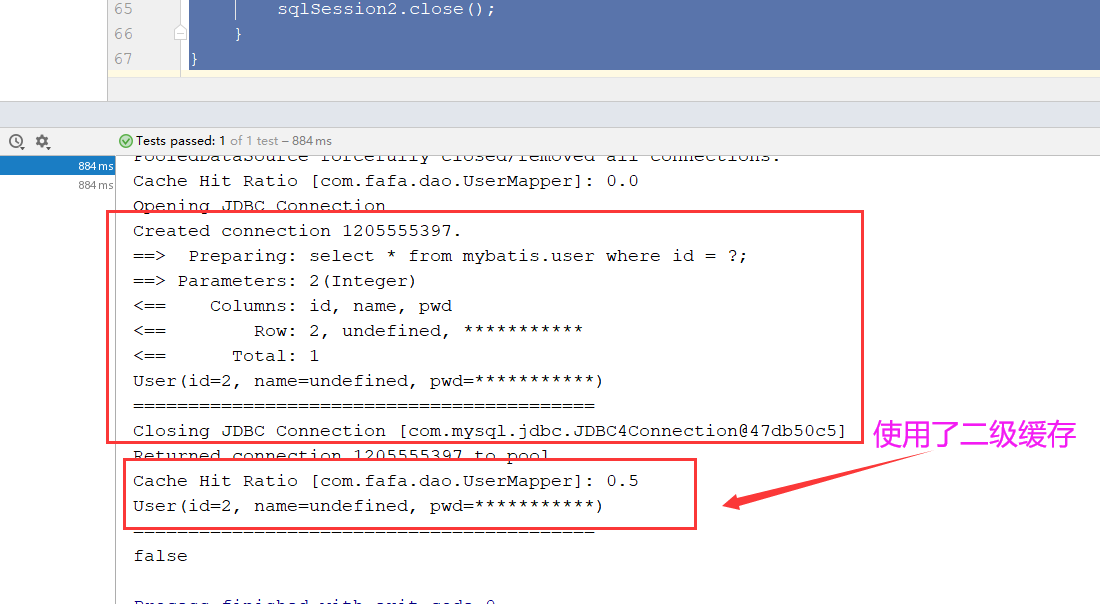
- 只要开启了二级缓存,我们在同一个Mapper中的查询,可以在二级缓存中拿到数据
- 查出的数据都会被默认先放在一级缓存中
- 只有会话提交或者关闭以后,一级缓存中的数据才会转到二级缓存中
13.9、缓存原理图
13.10、EhCache(自定义缓存)
第三方缓存实现–EhCache: 查看百度百科
Ehcache是一种广泛使用的java分布式缓存,用于通用缓存;
要在应用程序中使用Ehcache,需要引入依赖的jar包
<!-- https://mvnrepository.com/artifact/org.mybatis.caches/mybatis-ehcache -->
<dependency>
    <groupId>org.mybatis.caches</groupId>
    <artifactId>mybatis-ehcache</artifactId>
    <version>1.1.0</version>
</dependency>
在UserMapper.xml中使用对应的缓存即可
<mapper namespace = “org.acme.FooMapper” >
    <cache type = “org.mybatis.caches.ehcache.EhcacheCache” />
</mapper>
编写ehcache.xml文件,如果在加载时未找到/ehcache.xml资源或出现问题,则将使用默认配置。
<?xml version="1.0" encoding="UTF-8"?>
<ehcache xmlns:xsi="http://www.w3.org/2001/XMLSchema-instance"
         xsi:noNamespaceSchemaLocation="http://ehcache.org/ehcache.xsd"
         updateCheck="false">
    <!--
      diskStore:为缓存路径,ehcache分为内存和磁盘两级,此属性定义磁盘的缓存位置。参数解释如下:
      user.home – 用户主目录
      user.dir – 用户当前工作目录
      java.io.tmpdir – 默认临时文件路径
    -->
    <diskStore path="./tmpdir/Tmp_EhCache"/>

    <defaultCache
                  eternal="false"
                  maxElementsInMemory="10000"
                  overflowToDisk="false"
                  diskPersistent="false"
                  timeToIdleSeconds="1800"
                  timeToLiveSeconds="259200"
                  memoryStoreEvictionPolicy="LRU"/>

    <cache
           name="cloud_user"
           eternal="false"
           maxElementsInMemory="5000"
           overflowToDisk="false"
           diskPersistent="false"
           timeToIdleSeconds="1800"
           timeToLiveSeconds="1800"
           memoryStoreEvictionPolicy="LRU"/>
    <!--
      defaultCache:默认缓存策略,当ehcache找不到定义的缓存时,则使用这个缓存策略。只能定义一个。
    -->
    <!--
     name:缓存名称。
     maxElementsInMemory:缓存最大数目
     maxElementsOnDisk:硬盘最大缓存个数。
     eternal:对象是否永久有效,一但设置了,timeout将不起作用。
     overflowToDisk:是否保存到磁盘,当系统当机时
     timeToIdleSeconds:设置对象在失效前的允许闲置时间(单位:秒)。仅当eternal=false对象不是永久有效时使用,可选属性,默认值是0,也就是可闲置时间无穷大。
     timeToLiveSeconds:设置对象在失效前允许存活时间(单位:秒)。最大时间介于创建时间和失效时间之间。仅当eternal=false对象不是永久有效时使用,默认是0.,也就是对象存活时间无穷大。
     diskPersistent:是否缓存虚拟机重启期数据 Whether the disk store persists between restarts of the Virtual Machine. The default value is false.
     diskSpoolBufferSizeMB:这个参数设置DiskStore(磁盘缓存)的缓存区大小。默认是30MB。每个Cache都应该有自己的一个缓冲区。
     diskExpiryThreadIntervalSeconds:磁盘失效线程运行时间间隔,默认是120秒。
     memoryStoreEvictionPolicy:当达到maxElementsInMemory限制时,Ehcache将会根据指定的策略去清理内存。默认策略是LRU(最近最少使用)。你可以设置为FIFO(先进先出)或是LFU(较少使用)。
     clearOnFlush:内存数量最大时是否清除。
     memoryStoreEvictionPolicy:可选策略有:LRU(最近最少使用,默认策略)、FIFO(先进先出)、LFU(最少访问次数)。
     FIFO,first in first out,这个是大家最熟的,先进先出。
     LFU, Less Frequently Used,就是上面例子中使用的策略,直白一点就是讲一直以来最少被使用的。如上面所讲,缓存的元素有一个hit属性,hit值最小的将会被清出缓存。
     LRU,Least Recently Used,最近最少使用的,缓存的元素有一个时间戳,当缓存容量满了,而又需要腾出地方来缓存新的元素的时候,那么现有缓存元素中时间戳离当前时间最远的元素将被清出缓存。
  -->

</ehcache>
合理的使用缓存,可以让我们程序的性能大大提升!

CSDN联合极客时间,共同打造面向开发者的精品内容学习社区,助力成长!
更多推荐


 1
1 0
0- 0


 已为社区贡献1条内容

所有评论(0)